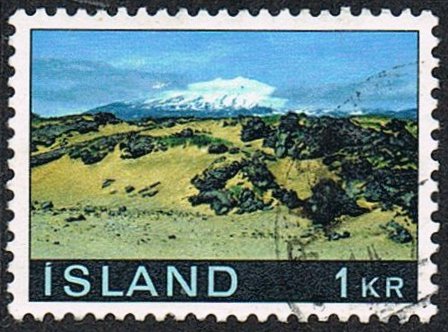
I'm currently busy listing Iceland, mainly 1970s to recent used. These are particularly nice issues, well designed and printed and generally inexpensive.
Regular mail service in
Iceland was first established by a charter of 13 May 1776, and on 1 January 1873, Iceland issued its first
postage stamps. The design was the same as for the
Danish numeral issue of the time (numeral of value surmounted by a crown all inside an oval), denominated with values ranging from 2 to 16
skilling, and inscribed
ÍSLAND. All are scarce or rare, and used copies are especially hard to find.
Chronology
In 1876 the
currency changed to
eyrir (pl.
aurar) and
króna. This meant new stamps, which were issued beginning in August. The same basic design, with some changes of color and perforation, continued in use through 1901. In 1897 a shortage of 3-aurar stamps led to the
overprinting of 5-aurur stamps with
þrir or
þrir / 3; these are rare, and unfortunately excellent
counterfeits have been produced.
In 1902 the numeral stamps were officially withdrawn and declared invalid for postage, since a new set depicting King
Christian IX was to be issued. But then the Minister of Iceland changed his mind for reasons which are still unclear and had the numerals reissued, overprinted
Í GILDI / '02--'03 in red or black, the overprint indicating that they were still valid. While some of the overprints are common, costing the collector less than a US$ or euro, others are among the great rarities of Icelandic philately. There are also many
inverts and typographical errors to be found.
In 1906 King Christian died, and so in 1907 a new series of stamps came out, featuring overlapping profiles of Christian IX and King
Frederick VIII.
1911 saw Iceland's first
commemorative stamps, a set honoring
Jón Sigurðsson on the 100th anniversary of his birth. In February of the following year, a set was issued with Frederick's silhouette. Although Frederick died in May 1912, no new stamps were issued until 1915, when another set of the 1907 design was issued in new colors.
King
Christian X first appeared on Icelandic stamps in a new set of 1920. Periodic stamp shortages plagued the postal service during the 1920s, and locally surcharged stamps were produced in 1921, 1922, 1924, 1925, 1926, 1929, and 1930. The first pictorial, non-portrait stamps were issued in 1925, a set of five showing views of Iceland. Iceland's first
airmail stamp was issued in 1928; it was produced by overprinting a crude image of an airplane on a regular 10-aurar stamp.
In 1930, Iceland celebrated the 1000th anniversary of the
Althing with an attractive series of 15 regular and 5 airmail stamps featuring a wide variety of historical, mythological, and scenic images. In 1928 Icelandic authorities received a proposal from the 'Society of the Friends of Iceland'
Verein der Islandsfreunde in
Vienna Austria, proposing to produce these stamps as a gift to Iceland for the Millenary celebrations. Against the advice of the Head Postmaster,
Sigurður Briem, the Icelandic government accepted the offer to produce 813,000 kronur's worth of stamps, 600,000 kronur's worth of which were to go to Iceland, and the rest to the Society for its trouble. Iceland's share of the stamps were delivered in December 1929, but in 1930 it became apparent that a fraud had been committed and a much larger than authorised number of stamps had been produced, by the insertion of the figure '1' before the value in the print order. Police investigations had not been completed before the outbreak of
World War II, and were not resumed afterwards.
In May 1931, stamps were overprinted
Zeppelin / 1931 for use on mail sent via the
airship Graf Zeppelin, which visited
Reykjavík on 1 July. The zeppelin did not actually land, there being no facilities, but it got low enough to pass mail bags up and down.
Also in 1931, a new issue came out depicting the
Gullfoss waterfall. In addition, stamps of the 1920 issue, but with the
vignette of the king much more finely engraved, started appearing periodically, through 1937.
Iceland's first
semi-postal stamps appeared in 1933. The subjects of the three stamps depicted categories of recipients; rescue workers, children, and the elderly.
In 1938 a dramatic series featured images of
Geysir, the namesake of all other
geysers.
Iceland again honored Jon Sigurðsson on its issue marking the independent republic established on 17 June 1944 (and again on the 150th anniversary of his birth on 17 June 1961 and the centenary of the deaths of Sigurðsson and his wife, Ingibjorg Einarsdóttir, in 1979).

Hekla eruption of 1947 on Icelandic 25-aurar stamp of 1948
In 1948, the eruption of the
volcano Hekla was marked by another set of dramatic images.
Since independence, Iceland has pursued a relatively restrained stamp-issuing policy, bringing out about 20 new stamps each year. There are annual
Christmas and
Europa issues, and sets depicting local scenery, flora, and fauna, as well as heritage and the works of local artists.
Iceland is a
Nordic island country between the
North Atlantic and the
Arctic Ocean. It has a population of 329,100 and an area of 103,000 km
2 (40,000 sq mi), making it the most sparsely populated country in Europe. The capital and largest city is
Reykjavík. Reykjavík and the surrounding areas in the southwest of the country are home to over two-thirds of the population. Iceland is
volcanically and
geologically active. The interior consists of a plateau characterised by sand and
lava fields, mountains and glaciers, while many
glacial rivers flow to the sea through the lowlands. Iceland is warmed by the
Gulf Stream and has a temperate climate, despite a high latitude just outside the
Arctic Circle.
Until the 20th century, Iceland relied largely on fishing and agriculture. Industrialisation of the fisheries and
Marshall Plan aid following
World War II brought prosperity and Iceland became one of the wealthiest and most developed nations in the world. In 1994, Iceland became party to the
European Economic Area, which supported diversification into economic and financial services.